Hear where your prose limps
Your eyes lie when you reread your own writing. They skate over the missing word, forgive the sentence that does not land, and read what you meant instead of what you wrote. Your ears do not.
Reading a manuscript aloud is old advice, and any word processor can do it. What none of them can do is take the correction. You hear the bad paragraph, and then you have to be at a desk to fix it.
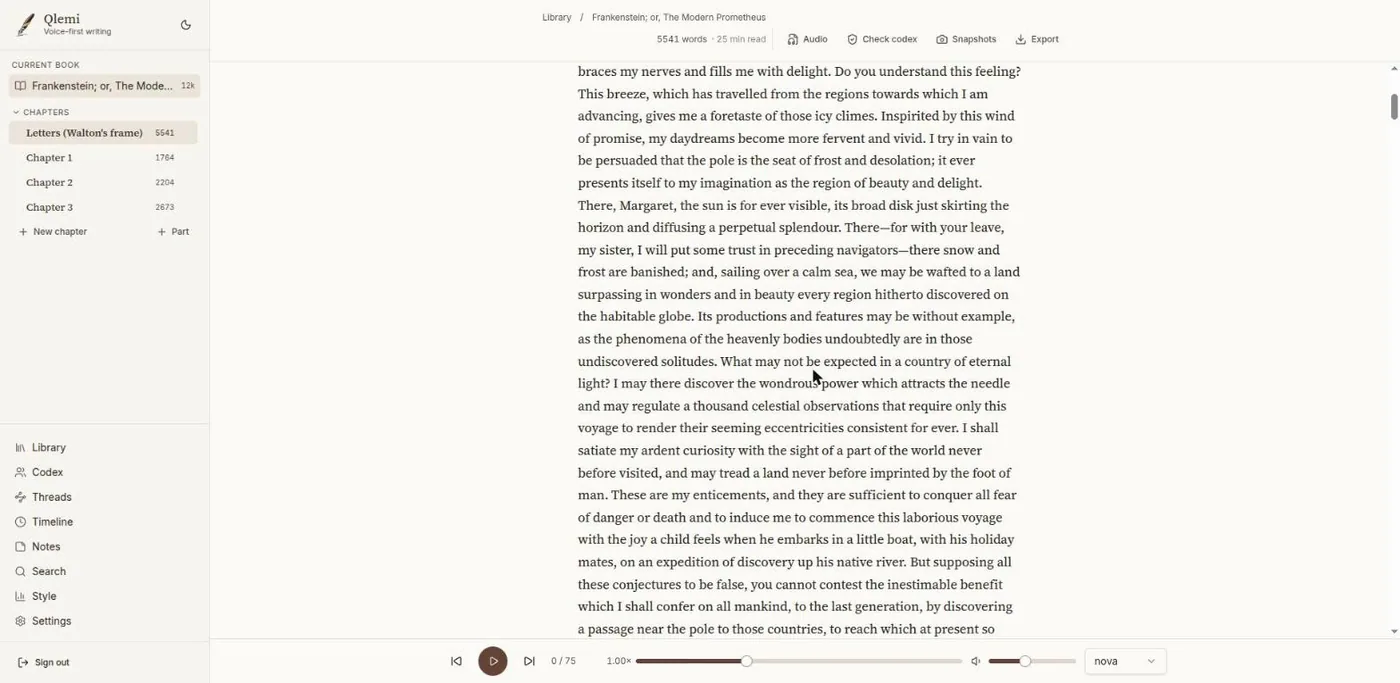
Qlemi closes that loop. Listen with headphones on a walk, flag what limps, and speak the replacement. The paragraph is the unit of everything: of playback, of flagging, of re-dictation.
The loop
- Listen. Press play on any paragraph and the book reads itself to you, at 0.5x to 2x. Audio is generated once and cached, so listening to the same chapter again costs nothing and starts instantly.
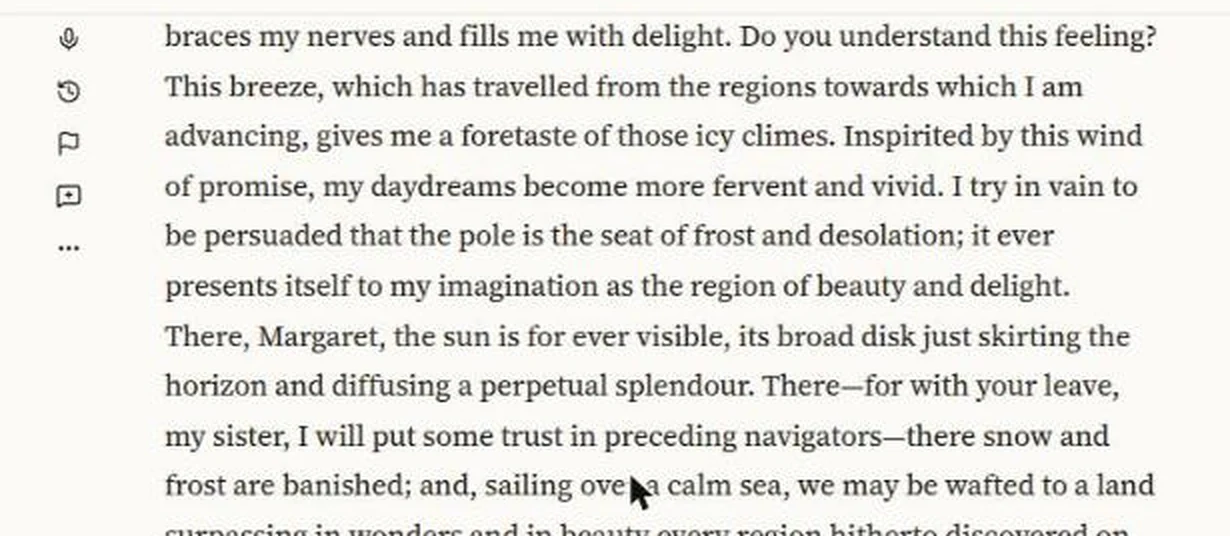
- Flag. A paragraph lands wrong. Press F, or tap the flag. You keep listening. Everything you flagged is waiting in one list when you sit down.
- Re-dictate. Hold the button and say the paragraph again. It is transcribed, tidied for punctuation and dialogue formatting, and shown to you side by side with the old version. Nothing is replaced until you accept it.
- Keep the old one. Every version of every paragraph is kept. You can always go back and read what you wrote the first time.
The cleanup pass does not write for you. It fixes punctuation, capitalisation, paragraph breaks and dialogue formatting, and strips the ums. It is told, in as many words, not to rewrite, embellish or change your meaning. If you want a machine to improve your sentences, this is the wrong tool, deliberately.
A codex that earns its place
Characters, locations, items, factions, relationships, plot threads and a timeline. Not because a writing tool ought to have them, but because they make the voice loop better.
Build it from the book
One pass over the manuscript proposes entries with a mention count taken from the prose, not from a model. A name the book never uses is never offered.
Correct names when you speak
Your character and place names are passed to the transcriber, so dictating an invented name spells it the way your book does.
A voice per character
Give a character their own reading voice and their dialogue is read in it, wherever the prose clearly names them as the speaker.
Check a chapter against it
Ask whether a chapter contradicts what the codex says. Eye colour, a death, a place someone should not be in yet.
Your book stays yours
Import
Word documents, Markdown or plain text. The chapter split is shown to you as a preview and you confirm it before anything is saved.
Export
Back to docx or epub whenever you want, no questions and no lock-in. Nobody should move a hundred thousand words into a tool without a way out.
Nothing is destroyed
Deleting a paragraph is one click with undo in the toast. Deleting a chapter asks first. Every old version of your prose is kept.
Snapshots
Freeze the state of a book before a big revision, and compare against it afterwards.
What Qlemi is not
It does not write your novel. There is no generate button, no suggested next sentence, no AI prose anywhere in your manuscript. The machine reads to you and listens to you; the words stay yours.
It is also small, in active development, and built by one person. Where your text goes is written out in full on the privacy page, and what protects it is on the security page, including the parts that are not finished.